Key Points
- Custom cabinets provide unlimited sizing, layout flexibility, and design control, while semi-custom cabinets work within predefined cabinet box options.
- Semi-custom cabinets offer a wider cost range and more predictable pricing, whereas custom cabinets vary based on design complexity and craftsmanship.
- Space efficiency, material quality, and long-term durability increase as you move from stock to semi-custom to fully custom cabinetry.
Built to Fit or Built to Choose? Let’s Break It Down
Are you trying to decide between custom cabinets vs. semi-custom and wondering how much the difference actually matters in a real kitchen remodel? Are semi-custom cabinets enough, or do fully custom cabinets justify the jump in cost and complexity?
In this post, you’ll learn how custom cabinetry and semi-custom cabinetry compare across design freedom, cost, materials, space efficiency, and long-term value.
By the end, you’ll be able to choose the right option for your kitchen design, your budget, and how you actually live in your home.
Custom Cabinets vs. Semi-Custom Cabinets
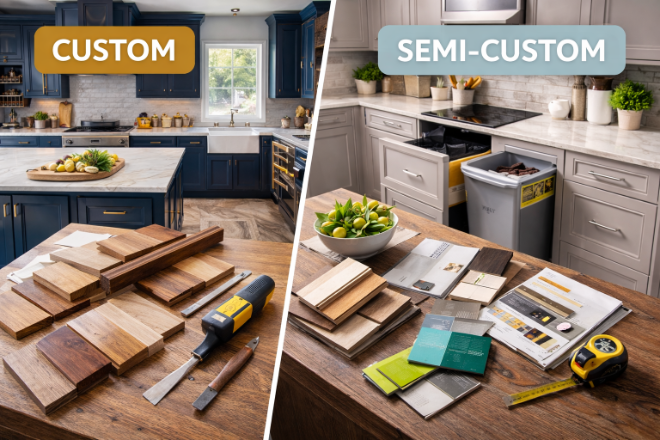
The main difference between custom and semi-custom cabinets is flexibility and precision. Custom cabinets are built to exact specifications without size or design limits, making them ideal for complex layouts or unique storage needs. Semi-custom cabinets use standard sizes with selectable features, offering more affordability and faster lead times than full custom builds.
| Comparison Factor | Custom Cabinets | Semi-Custom Cabinets |
|---|---|---|
| Level of customization | Built to exact specifications with no preset limits | Modified versions of standardized cabinet boxes |
| Sizing flexibility | Fully customizable dimensions | Limited to manufacturer size options |
| Design freedom | Unlimited layouts, configurations, and features | Constrained by available styles and options |
| Cost range | $500–$1,400 per linear foot | $150–$1,400 per linear foot |
| Space efficiency | Maximizes every inch of space | May require fillers due to standard sizing |
| Longevity | Built as a long-term or lifetime investment | More durable than stock, less than fully custom |
| Manufacturing approach | One-off, made-to-order | Semi-prefabricated with selectable modifications |
What Are Custom Cabinets vs. Semi-Custom Cabinets?
What Are Custom Cabinets?
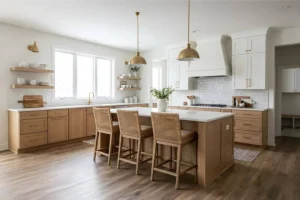
Custom cabinets are built to fit your exact space, storage needs, and kitchen layout, with no preset dimensions or stock components. They offer complete design flexibility and are often used in high-end remodels where unique layouts or design goals require tailored solutions. Custom options also allow for higher-quality materials and finishes not found in standard lines.
If you’ve walked through older homes near Davenport, you’ve likely seen kitchens where standard cabinetry simply wouldn’t fit cleanly without building custom cabinets from the ground up.
Riverbend Kitchens offers cabinetry-only services for homeowners who want custom kitchen cabinets designed for their exact space, whether they’re working with their own installer, another remodeler, or building new construction. We focus on cabinet design consultation and selection without requiring a full remodel.
What Are Semi-Custom Cabinets?
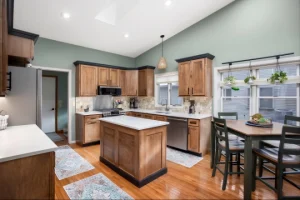
Semi-custom cabinets are factory-built boxes with customizable options like door styles, wood types, finishes, hardware, and limited size adjustments. They offer more design flexibility than stock cabinets without the higher cost of full custom work. This makes them a practical choice for homeowners seeking tailored style on a controlled budget.
Cabinet Customization and Design Flexibility
Custom Cabinet Design Capabilities
With custom kitchen cabinets, you’re not choosing from a menu—you’re creating something from scratch.
Cabinet sizes, depths, heights, drawer configurations, and internal features are all adjustable. Custom cabinets provide solutions for awkward corners, tall ceilings, or kitchens where every inch of space matters.
This flexibility is especially valuable when working with a kitchen designer who’s tailoring cabinetry around how you cook, store, and move through the kitchen.
Quality custom cabinetry also allows for precise craftsmanship, higher-quality materials, and unique construction details that simply aren’t available in semi or stock options.
Riverbend Kitchens approaches cabinet design collaboratively, focusing on workflow, zones, storage efficiency, and real-world use rather than pushing preset styles. We treat finishes as subjective and shape the design around how you actually use your kitchen.
Semi-Custom Cabinet Design Capabilities
Semi-custom cabinets offer meaningful, but limited, customization.
You’ll have more door styles, finishes, and modifications than stock cabinets, and you can often tweak cabinet widths or add features like pull-out drawers or specialty storage.
That said, semi-custom cabinets still rely on predefined cabinet box sizes.
You’re choosing from available options rather than defining every detail.
For many homeowners, this balance of customization and structure works well for a basic kitchen or a straightforward remodeling project.
Design Limitations Compared Side by Side
Fully custom cabinets have no preset constraints.
Semi-custom cabinetry does.
If your design vision or room layout pushes beyond what semi-custom lines allow, you’ll either compromise the design or move into full custom territory.
Cost Differences Between Custom and Semi-Custom Cabinets
How Much Do Custom Cabinets Cost?
Custom cabinets typically range from $500–$1,400 per linear foot.
That cost reflects one-off construction, higher-quality materials, skilled craftsmanship, and the time involved in designing and building each cabinet specifically for your kitchen.
You’re paying for precision, flexibility, and long-term quality rather than factory efficiency.
Riverbend Kitchens offers custom cabinet pricing tiers that start at $6,000 for Standard Cabinetry, $12,000 for Deluxe Cabinetry, and $20,000 for Premium Cabinetry.
How Much Do Semi-Custom Cabinets Cost?
Semi-custom cabinets range from $150–$1,400 per linear foot, depending on how far you push customization options. Basic semi-custom configurations stay closer to the lower end, while upgraded woods, finishes, and features can approach custom pricing.
This wide range is why semi-custom cabinetry is often seen as a flexible budget option.
Cost Predictability and Budget Control
Semi-custom cabinets are generally more predictable in cost because the factory sets clear pricing tiers. If tight budget control is a priority, semi-custom may feel like the safer choice.
Custom cabinetry varies more because every design choice affects materials, labor, and construction time.
Cabinet Fit, Sizing, and Space Efficiency
How Custom Cabinets Handle Space
Custom cabinets are built to exact dimensions, which means no filler panels, no wasted gaps, and no awkward transitions.
This is especially valuable in kitchens with older layouts, uneven walls, or unique footprints.
In homes near historic districts, custom cabinets often make the difference between a kitchen that feels intentional and one that feels patched together.
How Semi-Custom Cabinets Handle Space
Semi-custom cabinets rely on standard cabinet box sizes.
When your layout doesn’t line up perfectly, fillers are used to bridge gaps. While this doesn’t impact installation quality, it can reduce usable storage and slightly affect the finished look compared to fully custom cabinets.
Cabinet Durability, Longevity, and Long-Term Value
Longevity of Custom Cabinets
Custom cabinets are designed as a long-term or lifetime investment.
They’re built with higher-quality materials, solid wood options like oak, and durable joinery that holds up over time. When properly cared for, custom cabinetry maintains both functionality and appearance for decades.
This durability can also contribute to stronger resale value, especially when buyers recognize exceptional quality and craftsmanship.
Riverbend Kitchens uses a simplified Standard / Deluxe / Premium cabinet tier system, where higher-tier custom lines offer expanded finishes, sizing flexibility, and lifetime warranties that are uncommon in standard cabinetry options.
Longevity of Semi-Custom Cabinets
They’re a solid long-term option, just not the top tier.
Semi-custom cabinets are higher-quality than stock cabinetry but typically don’t match the lifespan of fully custom cabinets. Materials, construction methods, and factory limitations all play a role.
How Stock Cabinets Provide Context for the Comparison
Stock cabinets are off-the-shelf, factory-produced cabinets built in fixed increments.
They’re useful as a comparison point because semi-custom cabinets improve on stock cabinetry, while custom cabinets move beyond it entirely.
Cost and Construction Context
Stock cabinets typically range from $75–$400 per linear foot and often use particle board and basic construction methods. They’re budget-friendly but limited in durability, customization, and long-term value, which highlights why many homeowners move toward semi-custom or custom options.
Choosing Between Custom and Semi-Custom Cabinets Based on Priorities
When Custom Cabinets Are the Better Choice
Custom cabinets make sense when your kitchen has layout challenges, when you want full control over design and materials, or when long-term quality matters more than upfront cost.
Choosing custom often means fewer compromises and a kitchen that truly fits your home.
When Semi-Custom Cabinets Are the Better Choice
Semi-custom cabinets are the right choice when you want more options than stock without committing to full custom pricing.
They work well for standard layouts, predictable budgets, and homeowners who want stylish, higher-quality cabinets without pushing into full custom territory.
Riverbend Kitchens helps homeowners weigh these tradeoffs during the design process so expectations around cost, scope, and timelines are clear before any cabinets are ordered or installed.
Cabinets That Fit Your Life, Not Just Your Walls with Riverbend Kitchens
Riverbend Kitchens helps you navigate the real differences between custom cabinets and semi-custom cabinets by grounding every decision in your space, your priorities, and how you actually use your kitchen. We guide you through design flexibility, cost implications, material quality, and long-term value so you can move forward with clarity instead of second-guessing.
Whether you’re planning a full kitchen remodel or upgrading cabinetry as part of a larger remodeling project, choosing the right cabinets has long-term consequences for functionality, durability, and resale value.
Fill out our contact form today or give us a call to start designing kitchen cabinets that fit your home and your goals.
FAQs
Are semi-custom cabinets worth the money?
Semi-custom cabinets are worth the money for most homeowners because they balance cost, quality, and personalization better than stock or fully custom options. They offer expanded choices in finishes, sizes, and hardware while fitting more budgets and timelines. Many semi-custom lines also allow upgrades like soft-close drawers or pull-out organizers.
What is the 1 3 rule for cabinets?
The 1/3 cabinet rule suggests choosing hardware that’s one-third the width of a drawer or height of a door for balanced proportions and ease of use. This rule helps avoid oversized or undersized pulls that disrupt design flow. On a 39″ drawer, for example, a pull around 13″ long maintains aesthetic symmetry.
What is considered high grade cabinet?
High-grade cabinets feature:
- All-plywood construction.
- Full-height backs.
- Dovetail hardwood drawers.
- Soft-close hardware.
- Factory assembly for durability and precision.
- Face frames.
- Custom modifications.
These materials and construction methods support long-term performance and resale value in premium kitchens.