Key Points
- White oak kitchen cabinets offer a durable, moisture-resistant hardwood with calm grain and neutral tones that work in modern, transitional, and traditional kitchens.
- Board cut, lumber grade, and finish choice (natural, stained, painted, or specialty) dramatically change the look and performance of white oak cabinetry.
- Coordinating white oak with the right countertops, hardware, and wall colors creates a balanced kitchen style that can evolve over time without a full remodel.
How White Oak Quietly Transforms A Kitchen
Thinking about updating your kitchen, but don’t want something that feels cold, trendy, or dated in five years? Wondering how to balance a clean, modern look with the warmth and character of real wood?
In this guide, you’ll discover what sets white oak kitchen cabinets apart, how the wood is cut and finished, and how to pair it with countertops, hardware, and colors for a cohesive kitchen style.
By the end, you’ll understand how white oak can help you create a functional, durable, and timelessly elegant kitchen.
What Makes White Oak Kitchen Cabinets a Smart Choice?
White oak kitchen cabinets offer a durable, versatile option that blends classic and modern appeal. With a Janka rating of 1360 lbf, white oak resists dents and wear in high-traffic kitchens. Its neutral tones and controlled grain suit modern, traditional, and transitional styles while pairing easily with various finishes.
It offers a strong combination of:
- A calm, natural look.
- Durable performance in a high-use room.
- Flexibility to pair with light or darker finishes, stone, and metal accents.
For homeowners from riverfront neighborhoods near Schwiebert Riverfront Park to quiet streets close to Scott County Park, that combination of strength, comfort, and modern aesthetics is a practical, long-term choice.
Design Benefits of White Oak in Today’s Kitchens
Warm, Natural Aesthetic Without Visual Overload
Older oak kitchens often relied on red oak with heavy honey stains and bold, arched grain.
The result could feel busy and dated.
White oak offers a different experience:
- Color: more neutral wheat and soft honey tones instead of strong yellow or orange.
- Grain: still visible, but smoother and more refined depending on how the board is cut.
- Overall impression: warm and welcoming, but not heavy.
In a bright kitchen that looks out toward places like Veterans Memorial Park in Bettendorf, white oak brings in warmth and depth so the room doesn’t feel stark.
In a smaller or darker room, it keeps things from feeling closed in the way a very dark stain sometimes can.
It’s a natural way to create balance.
Works Across Multiple Design Styles
White oak is highly versatile, which makes it useful if you want a kitchen that can evolve over time.
It fits comfortably into:
- Modern and contemporary designs: flat-panel doors, minimal hardware, clean lines.
- Transitional spaces: Shaker doors, simple profiles, light or medium stain.
- Farmhouse-inspired kitchens: white oak base cabinets with painted uppers and a straightforward tile backsplash.
- Scandinavian or Japandi style: lighter stain, open space, and a focus on natural materials.
Because white oak doesn’t lock you into one look, it pairs well with changes down the road, like new wall colors, different light fixtures, or updated hardware.
Moving Beyond the Oak of the Past
Much of the resistance to oak comes from memories of heavily stained red oak cabinets with little contrast or variety.
That look depended on one dominant wood tone across the kitchen, a strong cathedral grain pattern, and shiny finishes that highlighted every board.
White oak helps avoid that effect.
Its more subtle grain and lighter tone form a quieter backdrop.
When combined with contrasting elements—painted cabinets, stone countertops, tile backsplash, or mixed metals—you get the strength of oak without repeating the style of previous decades that you still see in some older homes around Milan and Coal Valley.
How Durable and Practical Are White Oak Kitchen Cabinets?
Hardness and Everyday Resilience
A kitchen is one of the hardest-working rooms in any house.
Cabinetry around the sink, dishwasher, and main prep areas needs to hold up to constant use.
White oak offers:
- A Janka hardness rating of about 1360 lbf, indicating strong resistance to denting.
- Visible grain patterns that help disguise minor surface marks over time.
- Solid performance in high-traffic zones like islands and lower cabinets.
That means less worry when a pan hits a door front, or someone bumps a stool into the island.
The combination of hardwood and visible grain allows white oak cabinets to age gracefully rather than looking tired after a few years.
Stability and Moisture Resistance
Kitchens deal with steam, splashes, and frequent changes in humidity. Some woods move more than others under these conditions.
White oak performs well because it has good dimensional stability, especially in certain cuts.
Its internal structure also includes natural growths called tyloses that reduce water absorption through the pores.
Historically, this wood has been used in moisture-heavy applications like barrels and boats.
In cabinetry, that translates to doors and drawers that are less likely to warp or cup when the weather shifts.
Long-Term Value Compared to Other Hardwoods
Compared with softer hardwoods, white oak is more resistant to everyday damage.
Its moisture resistance adds another layer of protection in kitchens.
Its neutral tone and adaptable style help it stay visually relevant longer.
For a kitchen remodel that’s expected to last for many years, using a durable hardwood like white oak can support both practical needs and long-term style.
Choosing the Right Cut and Grade for Your White Oak Cabinets
Not all white oak looks the same. The way the log is cut and the grade of the lumber both affect the final appearance and performance of your cabinetry.
Plain Sawn White Oak
- Shows the familiar “cathedral” grain pattern—arched shapes across the board.
- It’s the most common and efficient way to cut lumber.
- Works well for homeowners who like visible grain and a more traditional look.
Quarter Sawn White Oak
- Produces straighter grain with distinctive “ray fleck” patterns.
- Offers improved stability across the width of the board.
- It’s often used where a refined, craftsman-like appearance is desired.
Rift Sawn White Oak
- Has a very straight, even grain with little to no fleck.
- Provides the highest level of dimensional stability among the three.
- Lends itself to sleek, modern aesthetics and precise, inset cabinetry.
Quarter sawn and rift sawn boards require more careful cutting and yield fewer boards per log, which typically makes them more expensive.
Many homeowners use these cuts selectively on highly visible doors and panels to get the look and stability they want without pushing the entire budget toward premium boards.
Understanding Premium Lumber Grades
Lumber grade refers to how much clear, defect-free wood can be obtained from each board.
Higher grades include fewer knots and surface defects, provide more consistent color and tone, and make it easier to align grain across multiple doors and drawer fronts.
In a custom kitchen, specifying a higher grade of white oak supports:
- A more uniform overall appearance.
- Better performance when paired with high-quality finishes.
- Fewer visual distractions, so the design and form can stand out.
Choosing the right combination of cut and grade is part of shaping the final look and ensuring the cabinetry suits both the space and the homeowner’s expectations.
Finishing Options for White Oak Cabinets
The finish you choose for white oak cabinets has a major impact on tone, depth, and overall style.
The same wood can look light and airy, rich and classic, or dramatically darker.
Natural and Clear Finishes for a “Raw” Look
If you like the natural color of white oak, a clear or nearly clear finish can keep the wood looking close to raw while still protecting it.
This usually involves:
- Water-based topcoats designed to stay clear and resist yellowing over time.
- Specialized sealers or very light stains that prevent the wood from shifting too warm.
- Matte or low-sheen finishes that keep reflections down and grain texture visible.
This type of finish works especially well in open, light-filled kitchens that borrow views of tree-filled streets near Scott County Park or the wooded edges of Hennepin Canal Parkway, where homeowners want the wood to feel honest and understated rather than glossy.
Stain Colors That Highlight the Grain
Stain offers a broad range of tones while still showcasing grain patterns:
- Light stains and subtle washes maintain a fresh, modern feel.
- Medium honey or chestnut stains bring in classic warmth without recreating older red oak kitchens.
- Deeper stains, such as charcoal or espresso, can transform white oak into a strong focal point, particularly on an island or accent wall.
A good stained finish relies on careful sanding, even application, and a strong protective topcoat. When done well, the combination of stain and grain creates depth that doesn’t feel flat or one-dimensional.
Painted White Oak for Color with Subtle Texture
White oak can also be painted when a specific color is the priority.
Because it is an open-grain wood:
- The grain often remains faintly visible through the paint, adding quiet texture.
- The surface doesn’t become completely smooth the way painted maple might.
This can be a benefit for homeowners who like the look of painted cabinets but still want a sense of real wood underneath.
Painted white oak also pairs nicely with natural white oak accents—for example, painted perimeter cabinets with a white oak island or range hood.
Specialty Finishes: Glazed, Distressed, and Cerused
For a more distinctive look, several specialty finishes work especially well on white oak.
Glazing: a semi-transparent color laid over paint or stain, then wiped away, leaving darker color in recesses and edges to emphasize detail.
Light distressing or rub-through: selective sanding of corners and edges before the final topcoat to suggest gentle wear over time.
Cerusing or liming: pushing a light pigment into the grain, then wiping the surface so the grain lines stay lighter and more pronounced.
These finishes take advantage of white oak’s open grain and can add both texture and visual interest, whether the style leans rustic, transitional, or contemporary.
Coordinating White Oak Cabinets with the Rest of the Kitchen
Cabinetry is just one part of a complete kitchen. To get a cohesive space, it helps to think about how white oak will interact with stone, metal, paint, and light.
Countertops That Complement White Oak
White oak works well with many countertop materials because its calm, neutral tone fits both riverfront condos near Schwiebert Riverfront Park and more rural homes outside Eldridge.
Some common combinations:
White or off-white quartz: offers a clean backdrop and lets the wood be the warm element in the room.
Marble: adds movement and timeless elegance; the grain of quarter-sawn or rift-sawn white oak can complement marble’s veining.
Granite: available in lighter and darker colors, with polished or honed finishes for different levels of reflection.
Butcher block or other wood tops: useful in select areas, such as an island section or baking zone, to echo the cabinet wood without overwhelming the entire space.
Hardware as the “Jewelry” of White Oak Cabinets
Hardware choices fine-tune how modern or traditional a white oak kitchen feels.
Popular directions include:
- Matte black pulls for strong contrast and a cleaner modern edge.
- Brushed brass or warm gold tones for a softer, more sophisticated look.
- Brushed nickel or stainless-style finishes for a versatile, understated option.
Because white oak itself is fairly neutral, changing hardware later is an effective way to shift the style of the room without replacing cabinets.
Wall Colors and Overall Palette
Wall color and surrounding finishes set the mood around white oak cabinetry.
Well-suited options include:
- Soft whites and warm off-whites that keep the focus on the wood and counters.
- Warm grays and greige tones that provide a calm, neutral background.
- Muted greens or blues for a nature-inspired pairing with the wood.
- Deeper accent colors around select areas, such as charcoal or navy, that frame an island or built-in.
Because white oak doesn’t push strongly cool or warm, it adapts well across these palettes and helps connect the kitchen with nearby rooms for a smoother transition through the house.
Style Ideas and Layout Concepts Using White Oak
Islands, Accents, and Mixed-Cabinet Layouts
You don’t have to use white oak on every cabinet for it to make an impact. In many kitchens, it works best as one part of a larger composition.
Common layout strategies:
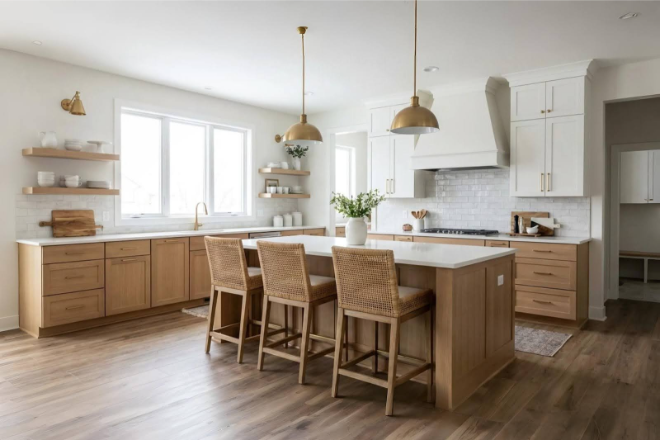
- White oak island with painted perimeter cabinets, providing warmth and a central focal point.
- White oak range hood or floating shelves that repeat the wood in a few key places.
- White oak pantry or hutch that visually ties the kitchen to adjacent living spaces.
Mixing finishes like this creates depth and dimension and makes it easier to adjust the look of the kitchen over time without replacing all the cabinetry.
Style-Specific Applications
Here are a few ways white oak can support different directions:
Modern: rift sawn white oak slab doors, integrated or minimal hardware, and a simple stone backsplash.
Updated farmhouse: white oak bases, smooth painted uppers, and straightforward hardware with a warm metal tone.
Transitional: white oak island or accent run paired with classic painted cabinets, simple door profiles, and a balanced mix of light and medium tones.
Scandinavian-inspired: lightly stained white oak, plenty of open space, and very simple hardware choices.
Because white oak is so adaptable, it provides room to fine-tune style through color, hardware, lighting, and decor instead of locking the kitchen into one very specific look.
Planning and Investment Considerations
Balancing Cost with Material and Cut Choices
Cabinetry is usually one of the biggest line items in a kitchen remodeling budget for homes in and around the Quad Cities, and white oak typically sits in the mid‑to‑upper range of wood options.
For context:
- Stock or basic semi-custom cabinets often run around $60–$300 per linear foot
- Custom wood cabinets can range roughly from $500–$1,200+ per linear foot
What you pay is shaped by several factors working together: the cut of the board, the grade of the lumber, and how broadly those upgrades are used.
Many homeowners choose to reserve the most premium cuts and grades for highly visible doors, panels, and island faces, and use more standard material in less noticeable areas.
Longevity and Maintenance
Because a kitchen is used every day, long-term performance matters as much as the initial look.
White oak supports that long view with its natural hardness, resistance to everyday dents, and grain that tends to disguise minor marks rather than draw attention to them.
When paired with modern, high-quality finishes, white oak kitchen cabinets stand up well to moisture, splashes, and frequent cleaning.
Day-to-day maintenance is simple: wipe surfaces with a soft cloth and a mild cleaner, and avoid abrasive pads or harsh chemicals.
Lasting Style in Every Door with Riverbend Kitchens
Riverbend Kitchens can help you design and build a kitchen that balances modern style, timeless warmth, and the way your household actually uses the space. We guide you through each decision so your kitchen feels intentional from the first door opening to the last drawer closed.
If you’re ready to explore how white oak can work in your home—whether you’re near Veterans Memorial Park in Bettendorf, close to Scott County Park outside Eldridge, or along the riverfront in Rock Island—fill out our contact form today or give us a call.
FAQs
Will white oak cabinets still in style in 2026?
White oak cabinets will remain in style through 2026 and beyond. Their neutral grain and warm tones adapt to changing trends through updated finishes. Choosing a simple door style and balanced stain ensures a timeless, versatile look that stays current over time.
What is the difference between white oak and red oak cabinets?
White oak has a tighter, straighter grain and cooler undertones, while red oak shows a more open grain with warmer, sometimes pinkish hues. White oak stains more evenly and suits light finishes, making it ideal for modern styles. Red oak works well with darker stains and traditional designs.
Are white oak cabinets durable for kitchens and bathrooms?
White oak is highly durable and moisture-resistant, making it an excellent choice for kitchens and bathrooms. Its dense structure and strong finish withstand daily wear, humidity, and splashes better than many softer woods, offering long-term reliability and visual appeal.