Door Wars: The Showdown Between Shaker and Flat Front
Are you stuck staring at cabinet samples, wondering which door style will still look right ten years from now? Do you want a kitchen that feels like you without spending hours decoding contractor jargon?
In this post, you will learn the real differences between shaker and flat-front cabinets, what each costs, how they clean, and how to pick the right cabinet style for your home.
By the end, you will have the confidence to walk into a showroom and know exactly which door belongs in your kitchen.
Shaker vs. Flat Front Cabinets at a Glance
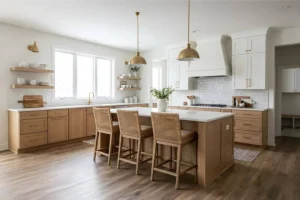
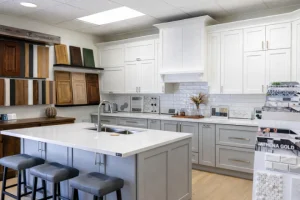
Shaker cabinets feature a five-piece door construction with a recessed center panel set within a clean, square frame, giving kitchens a classic design that works in both traditional and contemporary styles.
Flat panel cabinets, also called slab cabinets, feature a single smooth surface with no framing or trim, delivering a minimalist aesthetic suited to modern kitchens.
Here are the four practical differences between shaker and flat front cabinets:
- Look: Shaker has a framed door with a recessed center panel, while flat panel doors offer one uninterrupted smooth surface.
- Cost: Flat panel is usually more affordable because the simpler build uses less material and labor, while a shaker runs mid to high.
- Cleaning: Flat panel wipes down in seconds, while shaker recessed panels collect dust along the edges.
- Best fit: Shaker suits traditional, transitional, and farmhouse kitchens, while flat panel designs are strongest in modern and contemporary kitchens.
At Riverbend Kitchens, we offer both styles, including two-tone combinations like white uppers with grey lowers or sage green uppers with wood stain lowers, in finishes that include wood stain, white, navy, or blue, and grey.
How to Choose Between Shaker and Flat Front for Your Kitchen
The right cabinet style comes down to three things: your home’s architecture, the look you want, and how much daily cleaning you’re willing to commit to.
Both shaker and flat front cabinets are built from high-quality materials and will last for decades when made correctly.
The choice is really about which one fits your life and your style.
Choose Shaker If
The shaker style has been around since the 1700s and still looks fresh today.
That kind of staying power matters when you are about to invest in a kitchen remodel you want to enjoy for the next fifteen or twenty years.
Choose shaker cabinets when these things describe you:
- You want a look that will still feel current in 15 years.
- Your home is traditional, transitional, Craftsman, or farmhouse.
- You like the option to paint or stain and change finishes later.
- You value broad resale appeal over a single strong style statement.
Shaker also works well if you are blending old and new in your home and want one element that bridges both worlds.
Choose Flat Front If
Flat-panel cabinets offer a clean, low-maintenance look that complements open-concept layouts and newer homes beautifully.
The lack of ornate detailing shifts the focus to your countertops, lighting, and appliances rather than the cabinet doors.
Choose flat front when these things describe you:
- Your home is modern, contemporary, or newer construction.
- You want the easiest possible cleaning routine.
- You are drawn to bold colors, high gloss finishes, or wood veneers.
- You want cabinets that recede so other features take center stage.
If your kitchen is heavy on stainless steel appliances and clean architectural lines, flat-panel kitchen cabinets will feel right at home.
Why Mixing Both Styles Often Wins
Some of the best kitchens use both shaker and flat front in the same space.
You get the timeless charm of a shaker plus the sleek simplicity of a flat panel, without committing fully to either look.
Here are three mixing strategies that work well:
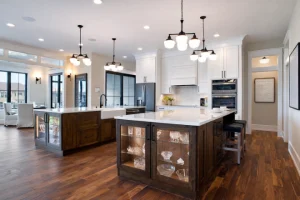
- Shaker on the perimeter with a flat panel on a multipurpose kitchen island for a modern focal point.
- Flat panel uppers with shaker lowers to add depth without overwhelming the eye.
- One style throughout, in two different colors, like white uppers and wood-stain lowers.
A lot of the kitchens we design at Riverbend Kitchens lean into two-tone combinations that give you the timelessness of a shaker without an all-in-one-note kitchen.
Cost Differences Between Shaker and Flat Front Cabinets
Flat-panel doors are generally less expensive to manufacture than shaker doors.
A flat door is a single piece with no frame, no recessed panel, and no extra joinery, which means fewer materials and less labor per door.
Shaker requires more craftsmanship because every door is a four-piece frame plus a center panel.
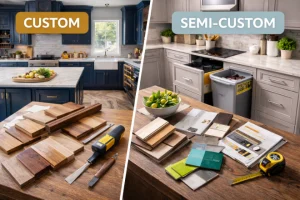
At Riverbend Kitchens, the cost difference between styles is real but smaller than the difference between custom and semi-custom construction.
Here is how our cabinet box pricing breaks down:
- Custom cabinet boxes: $1,000 to $1,300 per box.
- Semi-custom cabinet boxes: $650 to $1,000 per box.
A custom shaker door is not significantly more expensive than a custom flat-front door.
A custom cabinet of either style, though, runs significantly more than a semi-custom one.
If budget is your main constraint, the cabinet construction tier will move your total far more than the door profile.
That is good news, because it means you do not have to sacrifice the door style you really want to hit your number.
Riverbend Kitchens prices custom cabinet boxes at $1,000 to $1,300 per box and semi-custom boxes at $650 to $1,000 per box, which means the construction tier you pick will move your total more than the door style you pick. Many clients choose our premium cabinet line after we walk them through the design process, and all organizers and attachments are factory-installed.
Maintenance and Daily Cleaning
Cleaning is one of the most overlooked factors when choosing between shaker and flat-front cabinets.
Both styles are easier to maintain than raised-panel cabinets, which have far more grooves and details.
The real difference comes down to how the door is built and where dirt tends to settle.
Shaker Cleaning Reality
The grooves where the recessed center panel meets the square frame are the only real cleaning challenge with the shaker.
Dust, grease, and cooking residue settle in those edges over time, especially near the stove.
A weekly pass with a damp microfiber cloth along the recessed panels keeps them looking sharp.
Stained wood finishes hide buildup better than pure white paint, so if you cook a lot and want a shaker, a stain, or a slightly off-white paint will save you cleaning time.
Flat Front Cleaning Reality
A flat surface is the easiest cabinet door you can clean.
One wipe, edge to edge, done.
The trade-off is that high-gloss flat-panel doors show fingerprints and smudges more clearly than matte finishes or shaker doors.
Matte and textured flat panel finishes hide marks much better, and they still deliver the same modern look without the daily fingerprint patrol.
Design Versatility and Style Fit
Both shaker and flat-front cabinets pair with a wide range of countertops, backsplashes, and hardware.
The key is to match the door style to your home’s overall feel.
What Shaker Pairs With
Shaker is the chameleon of cabinet doors.
It works with quartz, granite, butcher block, marble, subway tile, brass hardware, brushed nickel, and matte black.
You can stain it, paint it, or order it in a custom color, and it still reads as classic.
Our design portfolio at Riverbend Kitchens shows shaker working alongside premium materials like quartz, granite, butcher block, and geometric subway or mosaic tile backsplashes.
You get a subtle detail in the door that adds character without locking you into one specific look.
Riverbend Kitchens designs shaker cabinets alongside premium materials, including quartz, granite, butcher block, and geometric subway or mosaic tile backsplashes. Our portfolio shows the door style holding up beautifully across all of these pairings.
What Flat Front Pairs With
Flat panel cabinets look strongest with stainless steel appliances, smooth stone countertops, and minimal hardware.
Some homeowners skip hardware altogether and use push-to-open mechanisms, or finger pulls built into the door edge.
Flat fronts are also a natural fit for kitchens with open-concept layouts, where the cabinets need to feel like architecture rather than furniture.
Pair flat-panel doors with integrated lighting and modern appliances, and the kitchen starts to feel like a cohesive design.
Color and Finish Direction
Finish and color choice can completely change how a door style reads in a room.
The same shaker door looks traditional in white and modern in matte black.
Here is a quick direction guide for each style:
- Shaker: Classic white or soft grey for timeless, navy or sage or black for bold but classic, and stained wood like walnut or oak for warmth.
- Flat front: Neutrals for a clean modern base, high gloss white or matte charcoal for drama, and wood veneers for warmth without losing the contemporary edge.
Painted doors can be repainted down the road, and solid wood doors can be sanded and refinished if your taste changes.
Resale and Long-Term Value
Cabinet door style affects how future buyers see your home, which matters even if you have no plans to sell soon.
Shaker has the broadest buyer appeal because the style is genuinely timeless and has survived every design cycle since the shaker community started building furniture in the 18th century.
For homeowners who plan to sell within ten years, a shaker is the safer choice because more buyers respond to it.
Flat-panel cabinets appeal strongly to buyers looking for modern, sleek kitchens, but they can read as too plain to buyers who prefer traditional homes.
In a neighborhood with a mix of buyer preferences, shaker hedges your bets.
In a neighborhood where most homes are new construction or modern in style, flat front matches the market and may outperform shaker on resale.
What really hurts resale is not the door style itself, but cheap construction, poor installation, or finishes that look dated within a few years.
What’s Trending in Cabinet Door Styles in 2026
Cabinet trends in 2026 are leaning warmer and more grounded than they were a few years ago.
The all-white kitchen is making room for color and texture, and both shaker and flat panel cabinets are showing up in finishes that feel more lived-in.
Here are the trends we are watching this year:
- Muted, grounded colors in both styles, including sage green, navy blue, and warm greys.
- Two-tone kitchens that use one door style with different colors on uppers and lowers.
- Handleless and push-to-open hardware on flat front cabinets for the cleanest look.
- Engineered wood and recycled materials with matte, scratch-resistant finishes.
- Soft-close drawers, integrated lighting, and charging stations are becoming standard.
At Riverbend Kitchens, we lean toward a clean, bright, modern aesthetic, which means both shaker cabinets in updated finishes and flat-panel kitchen cabinets fit naturally into the kitchens we design.
Your door style choice does not have to chase a trend.
The smartest move is to pick a style that matches your home and personal taste, then layer in finishes, hardware, and colors that feel current right now.
That way, when trends shift again, you can swap a paint color or a hardware set rather than replace your cabinets.
The Final Cut on Cabinet Doors from Riverbend Kitchens
Choosing between shaker and flat front cabinets is one of the biggest style decisions you will make in a kitchen remodel, and Riverbend Kitchens helps you sort through both options with a showroom consultation, design revisions, and full-service custom cabinetry.
We offer shaker, flat panel, and two-tone combinations in wood stain, white, navy or blue, and grey, paired with premium materials like quartz, granite, and butcher block to bring your vision to life.
Ready to find the right cabinet door for your kitchen?
Fill out our contact form today or give us a call.