Key Points
- Granite offers natural variation and strong heat resistance.
- Quartz provides consistent colors and lower maintenance due to its non-porous surface.
- Both materials are premium options with similar price ranges, chosen based on style and usage.
Stone Cold Decisions: Granite or Quartz?
Are you stuck choosing between quartz vs. granite countertops and wondering which one actually fits your kitchen design and daily wear? Do granite countertops really handle hot pans better, or are quartz countertops the smarter low-maintenance option for busy homes?
In this post, you’ll learn how granite and quartz differ in durability, maintenance, cost, and style.
By the end, you’ll be able to confidently choose the right countertop material for your kitchen remodel, your habits, and your long-term goals—without second-guessing your decision later.
Granite vs Quartz Countertops — Which Is Better?
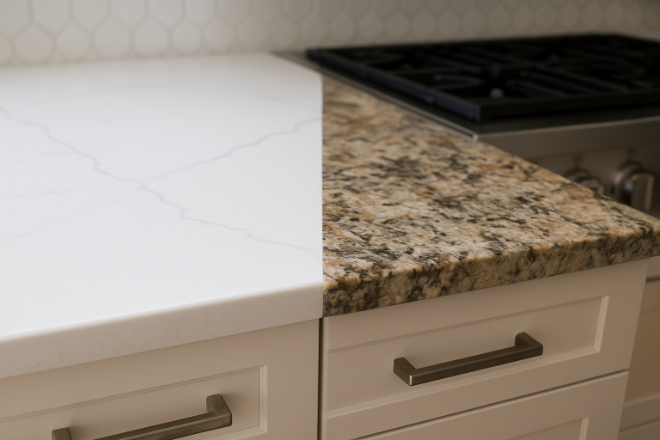
Granite and quartz both offer premium countertop performance, but each excels in different areas. Granite is more heat-resistant and natural; quartz offers better stain resistance, color consistency, and low maintenance. The better choice depends on how you use your space daily.
What Is Granite?
Granite is a natural stone formed deep beneath the Earth’s surface through intense heat and pressure. As an igneous rock, it’s quarried from the earth and cut into a granite slab, making every slab a one-of-a-kind product shaped by natural forces over time.
Granite Countertop Visual Characteristics
Granite countertops are known for unique patterns, mineral crystals, and organic movement that can’t be replicated.
No two slabs are the same, which is why homeowners who love natural materials often gravitate toward granite.
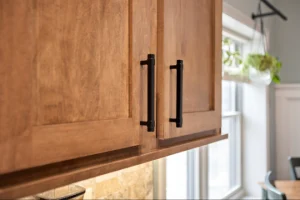
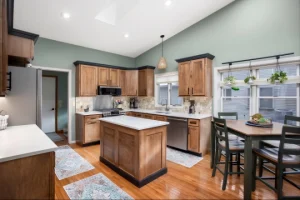
In homes near the Mississippi River in Davenport or overlooking the rolling terrain near Palmer Hills Golf Course in Bettendorf, granite’s natural variation often complements wood cabinetry and stone tile beautifully.
Granite Countertop Performance Traits
Granite is highly durable and offers excellent heat resistance, making it ideal near a cooktop where hot pans are common.
Because it’s a porous stone, granite can absorb liquids if it’s not properly sealed.
With proper sealing and routine maintenance, it holds up well in high-traffic areas and resists daily wear for decades.
What Is Quartz?
Quartz countertops are engineered stone surfaces made from crushed quartz—one of the hardest minerals on earth—combined with polymer resins and pigments.
This manufacturing process creates a dense, non-porous surface designed for consistency and durability.
Quartz Countertop Visual Characteristics
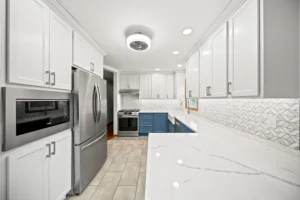
Quartz surfaces offer consistent colors and predictable patterns, including pure white options and marble-inspired designs.
This makes quartz popular in modern kitchens and bathrooms where symmetry and clean lines matter.
In newer homes around Eldridge or near the Riverfront Trail in Davenport, quartz countertops often anchor sleek kitchen design with thin slabs and minimal detailing.
Quartz Countertop Performance Traits
Quartz countertops’ pros include strong scratch resistance, a non-porous surface that resists stains, and no need for sealing.
Quartz does not handle extreme heat well, so hot pans should never be placed directly on the surface.
Appearance Differences Between Granite and Quartz Countertops
Granite Countertop Appearance
Granite delivers depth, movement, and natural variation that many homeowners view as artwork rather than just a surface.
Because each granite slab is unique, it’s often chosen for dream kitchen designs where the countertop is meant to stand out.
Homes near Black Hawk State Historic Site in Rock Island or surrounded by farmland near Geneseo often pair granite with wood finishes for a grounded, natural look.
Quartz Countertop Appearance
Quartz offers controlled, consistent patterns that work well in modern kitchens and bathrooms.
Its ability to mimic marble while maintaining durability makes it a popular countertop material for homeowners who want elegance without extra maintenance.
Quartz vs. granite often comes down to whether you prefer natural variation or a uniform surface.
Durability Comparison
Granite Countertop Durability
Granite is extremely durable and performs well under heat, making it forgiving around cooktops and ovens.
However, as a porous stone, it can stain if spills aren’t cleaned and the surface isn’t sealed.
Granite countertops perform best when properly sealed and maintained with mild soap and water.
Quartz Countertop Durability
Quartz countertops are engineered for durability and excel at resisting stains, scratches, and daily wear.
Their non-porous surface prevents liquids from soaking in, which is especially helpful in kitchens used heavily for cooking or baking.
Quartz does have lower heat resistance than granite, so protection from extreme heat is essential.
Maintenance Requirements
Granite Countertop Maintenance
Granite requires sealing about once a year to prevent staining and reduce its tendency to absorb liquids.
Routine cleaning with mild soap keeps the surface looking polished.
In homes with active kitchens—like those hosting gatherings after games at Modern Woodmen Park—this maintenance is manageable but important.
Quartz Countertop Maintenance
Quartz is truly low maintenance.
It doesn’t require sealing, resists stains naturally, and cleans easily with soap and water.
This makes quartz a strong choice for homeowners who want reliable performance without ongoing upkeep, like in busy households near places like the TBK Bank Sports Complex.
Cost Comparison
Granite Countertop Cost Range
Granite countertops typically fall in the mid to high price range, depending on color rarity and slab selection.
Material costs vary, but pricing is often calculated per square foot installed.
Exotic granite slabs can increase the price significantly.
Quartz Countertop Cost Range
Quartz countertops generally fall into a similar price range per square foot installed.
Certain styles—especially marble-look quartz or pure white options—may cost more.
When comparing quartz vs. granite countertops, price is usually less about the material itself and more about the specific slab or design chosen.
Home Resale Value
Granite Countertop Resale Appeal
Granite remains a recognizable premium feature that appeals to buyers who value natural stone and unique materials.
In established neighborhoods around Moline or East Moline, granite can signal craftsmanship and long-term durability.
Quartz Countertop Resale Appeal
Quartz appeals strongly to modern buyers who prioritize low maintenance and clean aesthetics.
In newer developments near the Bettendorf Trail System or Scott County Park, quartz countertops often align better with contemporary buyer expectations.
Environmental Considerations
Granite Countertop Environmental Factors
Granite is a natural material and biodegradable, but quarrying and transportation contribute to its environmental footprint.
Sealants used to prevent staining also factor into long-term environmental impact.
Quartz Countertop Environmental Factors
Quartz is man-made and not biodegradable, relying on polymer resins and manufacturing processes.
While durable, its environmental profile differs from natural stone due to its engineered composition.
Usage and Versatility
Granite Countertop Applications
Granite works well for kitchen countertops, bathroom countertops, and even outdoor installations due to its heat resistance and durability.
Its ability to handle direct sunlight and hot cookware makes it versatile in many environments.
Quartz Countertop Applications
Quartz is best suited for indoor kitchens and bathrooms where stain resistance and cleanliness matter most.
Its non-porous surface makes it ideal for high-traffic areas, though it should be protected from direct sunlight and extreme heat.
Trends and Preferences
Granite Countertop Selection Trends
Granite is seeing renewed interest in bold, dark, and dramatic slabs.
Homeowners drawn to expressive, natural surfaces often choose granite to create a focal point that feels timeless and rooted in the earth.
Quartz Countertop Selection Trends
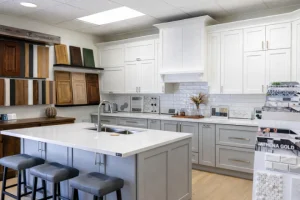
Quartz continues to dominate in modern kitchens, particularly with white cabinetry and marble-inspired patterns.
Its clean look and low maintenance appeal resonate with homeowners updating kitchens near Vander Veer Botanical Park or along the Riverfront in Rock Island.
Which One Is Best for You?
If you cook often and regularly set hot pans on the counter, granite countertops are usually the better choice. Granite is a natural stone formed beneath the earth’s surface, and its heat resistance makes it forgiving around a cooktop. It also offers unique patterns and character, but it does require sealing to prevent staining.
If you want the easiest day-to-day experience, quartz countertops are typically the better fit. Quartz is an engineered stone with a non-porous surface that resists stains, doesn’t absorb liquids, and never needs sealing. It works especially well in busy kitchens and bathrooms where low maintenance and consistent colors matter more than heat tolerance.
In the end, the right countertop material comes down to personal preference: choose granite for natural beauty and heat resistance, or quartz for durability, cleanliness, and minimal upkeep.
Craft a Kitchen That Works for You with Riverbend Kitchens
When you work with Riverbend Kitchens, we help you pick and install the best stone countertops for your home, whether that’s granite or quartz. We tailor the choice to your lifestyle, your kitchen design, and how you use your space every day.
Ready to upgrade your kitchen? Fill out our contact form today or give us a call.
FAQs
How long do quartz and granite countertops last?
Quartz and granite countertops both last for decades with proper care. While repair methods differ, both materials offer long-term durability in kitchens and bathrooms.
Why is quartz becoming more popular than granite?
Quartz is gaining popularity over granite due to its stain resistance, low maintenance, and consistent appearance—making it a top choice in modern kitchen design.
What is engineered stone and how does it relate to quartz?
Engineered stone refers to surfaces like quartz, made by combining crushed stone with resins. The result is a durable, non-porous countertop with uniform color and texture.